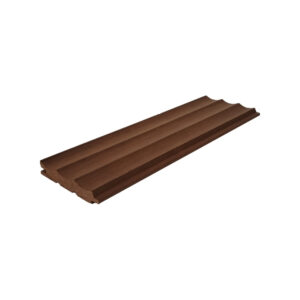
Thermo-treated aspen and Red Cedar can both be used to create a beautiful sauna, but they offer different looks and sensory experiences. Thermo-treated aspen is an appealing choice for anyone seeking smooth, knot-free and resin-free benches with a calm, consistent finish. Red Cedar is often chosen for its distinctive colour, grain and aroma. For benches in particular, the quality and finish of the individual boards matter as much as the choice of wood species.
What is thermo-treated aspen?
Thermo-treated aspen is aspen wood that has been modified using controlled heat and steam. Pieksäwood carries out this process at its facility in Pieksämäki. According to the company, its treatment temperature varies with the wood, its thickness and the desired colour. The process gives aspen a warm brown tone and reduces its tendency to absorb moisture and change shape as humidity varies. No chemical preservatives are added during heat treatment.
Aspen is valued for its fine, understated appearance. Pieksäwood’s thermo-treated aspen bench boards are described as knot-free and resin-free, with a smooth surface suited to direct contact with the skin. When choosing materials, check these qualities in the specific product: wood grade and finish can vary between suppliers.
Which feels more comfortable on sauna benches?
Both thermo-treated aspen and Red Cedar can make comfortable sauna benches. It would be misleading to say that thermo-treated aspen always stays cooler to the touch than Red Cedar without comparable measurements of the finished products under the same conditions.
Pieksäwood describes its thermo-treated aspen bench boards as smooth and comfortable even in a hot sauna. Their knot-free, resin-free surface is a practical benefit where people sit or lean against the wood. When comparing bench materials, look closely at the surface finish, board quality and installation rather than relying on a general claim that one species will always feel cooler.
Does Red Cedar or thermo-treated aspen last longer?
There is no reliable universal answer. A sauna wood’s service life depends on the particular product, installation, ventilation, cleaning and use. Red Cedar is known for its natural durability, while heat treatment improves aspen’s dimensional stability and reduces its moisture absorption compared with untreated aspen. Those properties do not, by themselves, establish which finished bench or panel will last longer in a particular sauna.
Whichever material you choose, follow the manufacturer’s installation and care instructions. Pieksäwood provides detailed care instructions for its wet-room wood products, which are worth consulting before and after installation.
Which wood should you choose if you are sensitive to scents?
Red Cedar’s characteristic aroma may be an important part of its appeal. If you prefer a subtler scent, thermo-treated aspen may suit your sauna better, although heat-treated wood can have a scent of its own. Pieksäwood notes that its heat-treated wood has a distinctive aroma that differs from that of untreated timber.
Neither material should be described as allergy-proof or universally safe for people with sensitivities. If a user has a known wood allergy or respiratory condition, their individual needs should guide the choice. Information about occupational exposure to cedar wood dust, for example, does not establish how a finished cedar sauna bench will affect every sauna user.
How do the materials compare in appearance?
Red Cedar is often selected for its reddish tones, visible grain and aromatic character. Its appearance varies from board to board, so the finished result depends on the product and grade selected.
Thermo-treated aspen offers a different look. Heat treatment gives Pieksäwood’s aspen a warm brown colour, while its knot-free bench boards create a clean, uninterrupted surface. This makes it well suited to a sauna design that calls for a smooth, restrained finish. The best way to judge the colour in your planned lighting is to compare physical samples.
Which is the more sustainable choice?
The answer depends on the specific products and their supply chains, not just the wood species. Origin, forest management, manufacturing, transport and expected service life all matter. A shorter journey from forest to customer may reduce transport needs, but distance alone is not enough to prove that one sauna material has a lower overall carbon footprint.
Pieksäwood says it manufactures its sauna benches and panels in Pieksämäki and uses PEFC- and FSC-certified aspen among its raw materials. Heat treatment uses heat and steam rather than chemical preservatives. Buyers who value traceable sourcing and Finnish manufacturing can consider these documented details alongside the specifications of the Red Cedar product they are comparing.
Which wood should you choose for your sauna?
Choose thermo-treated aspen if you want Pieksäwood’s smooth, knot-free and resin-free bench material, a consistent brown finish and wood products manufactured in Finland. Choose Red Cedar if its distinctive grain, colour variation and aroma are central to your design. For either material, compare actual samples and product specifications before making the final decision.
To find the right material for your sauna project, request samples of Pieksäwood’s thermo-treated aspen bench boards and compare them against the Red Cedar products you are considering before committing to a purchase. Contact us to request your samples.