Responsible wood sourcing in sauna design means selecting timber from sustainably managed forests, minimising waste across the production chain, and choosing species that perform well in sauna conditions without requiring harmful chemical treatments. It matters because the sauna environment places extreme demands on materials, and cutting corners on sourcing leads to products that degrade quickly, harm indoor air quality, and carry a hidden environmental cost. The sections below unpack the key questions anyone designing or specifying a sauna should ask before choosing their materials.
What makes wood sourcing ‘responsible’ in the sauna industry?
Responsible wood sourcing in the sauna industry means tracing timber back to verified, sustainably managed forests, keeping the supply chain as short and transparent as possible, and ensuring that as much of each log as possible is turned into a usable product rather than discarded as waste. For sauna applications specifically, it also means avoiding species treated with pesticides or synthetic preservatives, since heat releases whatever is embedded in the wood directly into the air you breathe.
Responsibility in sourcing covers several interconnected dimensions. Forest management is the starting point: timber should come from forests where harvesting rates do not exceed natural regeneration, biodiversity is protected, and local communities benefit from forestry activity. Certification schemes provide one signal of this, but origin and chain-of-custody transparency matter just as much.
Beyond the forest, responsible sourcing looks at what happens to the raw material once it is felled. A producer who saws, dries, modifies, and mills timber on one site wastes far less than one who ships raw logs across continents for each processing step. Shorter logistics also mean a smaller carbon footprint per cubic metre of finished product.
Finally, responsible sourcing considers by-product use. A sawmill that finds a purpose for every part of the log, including the knotty sections traditionally considered lower grade, demonstrates genuine commitment to circular principles rather than just marketing language.
How does wood species choice affect sauna sustainability?
Wood species choice directly affects sauna sustainability because different species vary widely in how fast they grow, how much processing they require, and how long they last in a hot, humid environment. A fast-growing, locally available species that performs naturally in sauna conditions will almost always have a lower environmental footprint than a slow-growing exotic species shipped from the other side of the world.
Aspen is one of the most sustainable choices for sauna wood. It grows abundantly across Scandinavia and Finland, regenerates quickly after harvesting, and is naturally knot-free and resin-free in its upper stem sections, which means it needs no chemical treatment to be safe in the heat. Its low thermal conductivity keeps bench surfaces comfortable even at high temperatures, and its smooth, pale surface does not harbour bacteria easily.
Black alder shares many of these properties and is similarly well suited to the moisture-rich sauna environment. Both species are native to Finnish forests, which means sourcing them locally avoids the transport emissions associated with imported exotics like abachi or obeche, which are sometimes marketed as sauna-grade alternatives. If you would like to explore our range of sustainably sourced sauna wood products, you can find full details on our website.
Species selection also influences longevity, which is itself a sustainability factor. A bench built from the right species, properly dried and finished, can last decades. One built from an unsuitable species, however attractively priced at the point of purchase, may need replacing within a few years, generating waste and repeat production costs.
What is thermally modified wood and why is it used in saunas?
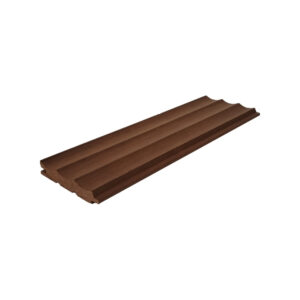
Thermally modified wood is timber that has been heated to high temperatures, typically between 160 and 230 degrees Celsius, using only heat, steam, and air, with no chemicals added. The process permanently alters the wood’s cell structure, making it more dimensionally stable, more resistant to moisture and biological decay, and darker in colour. In sauna design, it is used to extend the service life of the wood and to achieve a rich, warm tone without staining.
The sustainability credentials of thermal modification are significant. Because the process uses no biocides, preservatives, or synthetic resins, thermally modified wood remains safe to use in enclosed, heated spaces where off-gassing from treated materials would be a health concern. At the end of its life, it can be composted or disposed of as untreated wood waste.
Thermal modification also makes it possible to use species that would otherwise be unsuitable for demanding applications. Aspen, for example, is already an excellent sauna material in its natural state, but thermal modification deepens its colour to a warm brown, enhances its moisture resistance further, and makes it appropriate for outdoor applications such as exterior cladding or terrace structures where untreated aspen would not hold up.
We have been working with thermal modification for over twenty years, with a particular focus on aspen and black alder. Our in-house thermal modification facility in Pieksämäki processes timber that comes directly from our own sawmill, which means the entire journey from log to finished panel happens on one site. That level of control over the process is what makes it possible to guarantee consistent results across every batch.
How does a short supply chain improve sauna wood quality?
A short supply chain improves sauna wood quality by reducing the number of handoffs between harvesting and finished product, which limits the opportunities for moisture damage, inconsistent processing, and quality drift. When sawing, drying, thermal modification, and planing all happen in the same location under the same quality standards, every stage can be calibrated to the next, and problems can be caught and corrected before they compound.
Moisture control is the most critical factor. Wood that is sawn, then shipped to a separate drying facility, then shipped again for planing, passes through multiple humidity environments. Each transition creates risk: wood can absorb moisture in transit, arrive at the next stage outside the target moisture range, and produce a finished product that warps or cracks in service. When all stages happen on one site, moisture content is managed continuously from the moment the log is cut.
A short supply chain also makes traceability straightforward. When we saw Finnish aspen at our own mill in Pieksämäki and plane the finished panels at the same site, we know exactly where every board came from and how it was processed. That transparency is increasingly important to architects, builders, and consumers who want to verify the origin and handling of the materials they specify.
There is also a quality consistency argument. A producer who controls every step of the process can maintain tighter tolerances on dimensions, surface finish, and moisture content than one who coordinates multiple subcontractors. For sauna applications where benches must fit precisely and surfaces must be smooth enough to sit on comfortably, that consistency is not a luxury but a basic requirement. If you have specific questions about our production process, please get in touch with our team.
What should you look for when sourcing sauna wood responsibly?
When sourcing sauna wood responsibly, look for clear evidence of where the timber comes from, how it was processed, and whether the producer takes genuine steps to minimise waste and environmental impact across the full production chain. The most trustworthy suppliers are those who can answer these questions directly, not just point to a certification logo on their packaging.
Start with species and origin. Locally grown species such as Finnish aspen or black alder will almost always carry a lower transport footprint than imported alternatives, and they are proven performers in the sauna environment. Ask whether the supplier can name the country, and ideally the region, where the timber was grown.
Next, consider how the wood was processed. For thermally modified products, confirm that the modification was done using a heat-and-steam process without chemical additives. This matters both for indoor air quality and for end-of-life disposal. A product that has been chemically treated cannot be composted or recycled as cleanly as one that has only been exposed to heat.
Look at supply chain length. A producer who controls sawing, modification, and planing in one location offers better traceability and more consistent quality than one who assembles products from multiple sources. Short supply chains also tend to produce less transport waste and make it easier to verify environmental claims.
Finally, ask about by-product use and waste reduction. Producers who find a purpose for the full log, including knotty or lower-grade sections, demonstrate a more complete commitment to responsible production. Our Roots collection is a direct expression of this principle: it uses the knotty sections of Finnish aspen that are a natural by-product of premium, knot-free production, turning what was previously considered secondary material into a distinctive, characterful product in its own right.
- Species and origin: Prefer locally grown species with a documented regional source
- Processing method: For modified wood, confirm heat-and-steam treatment with no chemical additives
- Supply chain length: Favour producers who control multiple stages on one site
- Waste and by-product use: Ask how the producer uses lower-grade material from the same logs
- Traceability: The supplier should be able to tell you where the wood came from and how it was handled
Responsible sourcing is not a single checkbox but a combination of decisions that together determine whether a sauna project can genuinely claim to be built on sustainable foundations. The good news is that the most responsible choices, Finnish aspen, short supply chains, chemical-free thermal modification, also tend to produce the best-performing and longest-lasting sauna materials available.