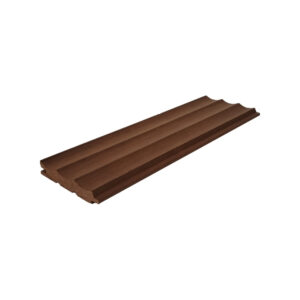
The main differences between thermo-treated and untreated aspen are colour, moisture absorption and dimensional stability. Untreated aspen keeps its naturally pale appearance. Thermo-treatment gives aspen a brown tone and reduces the amount of moisture it absorbs, helping it retain its dimensions as humidity changes. Both can be suitable for sauna interiors, provided you choose a product intended for the surface in question and care for it correctly.
What changes when aspen is thermo-treated?
Pieksäwood heat-treats wood with controlled heat and steam, without adding chemical preservatives. The process begins by drying the wood before raising it to the treatment temperature. Heat changes the wood’s structure, reduces its moisture absorption and produces a darker shade.
Thermo-treatment does not remove knots or determine the quality of the finished surface. Those depend on the raw material, product selection and finishing. Pieksäwood offers both knot-free thermo-treated aspen bench boards and thermo-treated aspen panels that feature natural knots. Browse the full range of Pieksäwood wood products for saunas to compare available options.
How do the materials handle sauna humidity?
Thermo-treated aspen absorbs less moisture and is more dimensionally stable than untreated aspen. This can be valuable where sauna surfaces are repeatedly exposed to changes in heat and humidity. It does not mean that treated boards cannot move, develop cracks or need maintenance.
Untreated aspen is also used for sauna benches and panels. For either material, installation, ventilation and drying after use are important. Thermo-treatment should not be treated as a solution to poor ventilation or water that remains on wooden surfaces. Pieksäwood recommends drying sauna wood thoroughly after use and ensuring adequate ventilation.
Does thermo-treated aspen feel cooler on a sauna bench?
Both untreated and thermo-treated aspen can provide a pleasant bench surface when the boards are suitably selected and finished. Pieksäwood describes its thermo-treated aspen bench boards as smooth, knot-free and resin-free.
It would be misleading to promise that one version always feels cooler than the other. Surface temperature and the sensation of touch depend on the conditions and the finished product. For bench comfort, check the smoothness and quality of the actual boards, including the edges and other surfaces that may touch skin.
Which lasts longer: thermo-treated or untreated aspen?
Heat treatment improves properties that can support durability, particularly moisture resistance and dimensional stability. That does not establish a fixed difference in service life between two installed saunas. Usage, construction, ventilation, cleaning and possible surface treatments also affect how long the wood remains in good condition.
Neither option is maintenance-free. Follow the manufacturer’s guidance for cleaning and drying the finished product, especially in a sauna that is used frequently.
How do thermo-treated and untreated aspen look?
Untreated aspen is light in colour and suits a bright sauna interior. Thermo-treated aspen offers a warmer brown appearance. The precise shade varies with the product and treatment, while the sauna’s lighting and any surface treatment also influence the final look. Pieksäwood advises comparing physical samples because product photographs cannot show the exact colour in every setting.
Neither colour remains identical forever. Wood is a natural material, and its appearance can change with use, cleaning, moisture and light.
When should you choose each option?
Choose untreated aspen if you want a pale sauna interior and the particular product meets your requirements for benches or panels. Choose thermo-treated aspen if you prefer a brown tone and value its reduced moisture absorption and improved dimensional stability compared with untreated aspen.
If you are more familiar with Red Cedar as a sauna wood, a few practical differences are worth noting. Cedar has a distinctive reddish-brown colour and a strong, characteristic scent that many people associate with saunas. Aspen, by contrast, is nearly odourless, which some bathers prefer, particularly those who are sensitive to strong wood scents. Untreated aspen is pale and light in tone, while thermo-treated aspen offers a warmer brown that may feel visually closer to Cedar without carrying Cedar’s pronounced aroma. Aspen is also naturally smooth and low in resin, which can make it a comfortable choice for bench surfaces that come into direct contact with skin. These are differences in character rather than a ranking — the right material depends on your priorities, your sauna’s design and the specific products available to you.
The final decision should be based on the specific board, not the treatment alone. Check whether it is intended for benches or panelling, whether it is knot-free if that matters to your design, and what care it requires. Requesting a sample from Pieksäwood is a practical way to compare the materials for your project before making a final choice.