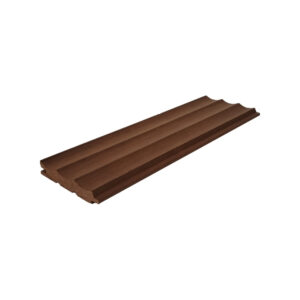
Knot-free, resin-free wood is a practical choice for sauna benches because it offers a smooth, consistent surface where people sit and lean against the material. Pieksäwood’s thermo-treated aspen bench boards combine these surface qualities with the warm brown appearance and improved dimensional stability gained through heat treatment. The exact qualities should always be checked from the chosen product, rather than assumed from the wood species alone.
Why does surface quality matter for a sauna bench?
A bench is in direct contact with bare skin, so its surface should feel smooth and be carefully finished. Knots can interrupt an otherwise even surface, particularly if they are loose or poorly finished. A knot-free board also creates a clean, continuous appearance across the seating area.
Resin-free wood avoids the risk of sticky resin appearing on the bench surface when heated. This is one reason Pieksäwood highlights the lack of knots and resin in its thermo-treated aspen bench boards. Neither quality removes the need to check the finish of the actual boards before installation.
It would be too strong to claim that every knot becomes hot enough to burn skin or that all knotty wood is unsuitable for a sauna. Where the knot is, whether the surface touches skin, and how the board is finished all matter. Visible knots can also be an intentional design feature on wall and ceiling panels.
What makes thermo-treated aspen suitable for sauna benches?
Pieksäwood describes its thermo-treated aspen bench boards as knot-free, resin-free and smooth. The material provides a restrained appearance, while heat treatment gives it a brown tone. For a sauna bench, these product-specific qualities make it an option when comfort and a consistent finish are priorities.
Aspen does not contain the resin associated with woods such as pine. Knot-free quality must still be confirmed from the specific product: aspen trees can have knots, and Pieksäwood’s Roots collection deliberately uses knotty Finnish aspen for panels.
What does heat treatment add?
Pieksäwood heat-treats wood using controlled heat and steam, without adding chemical preservatives. The process reduces moisture absorption and improves dimensional stability compared with untreated wood. It also changes pale aspen to a brown shade.
These properties are useful in a sauna, where humidity and temperature vary. They do not mean that a bench can never warp, crack or change colour. Installation and care still affect its long-term condition, and heat treatment does not remove knots from a board. Knot-free bench material is achieved through the selection and manufacture of the product.
How does thermo-treated aspen compare with Red Cedar?
Both thermo-treated aspen and Red Cedar can be used for sauna benches. Red Cedar has a distinctive colour, grain and aroma; Pieksäwood’s thermo-treated aspen offers a different look with a smooth, knot-free and resin-free bench surface.
If you are already familiar with Red Cedar, aspen may feel like unfamiliar territory. The differences are worth understanding. Red Cedar is known for its reddish-brown tone, its characteristic scent and a grain that varies noticeably between boards. Aspen, by contrast, is a pale, fine-grained wood with a neutral appearance and no natural aroma. Thermally modified aspen takes on a warmer brown tone through the heat treatment process, which also reduces its moisture absorption — a practical advantage in the humid conditions of a sauna. Because aspen contains no resin, there is no risk of resin seeping onto the bench surface when the wood heats up, which can be a consideration with some coniferous species. Neither material is the right choice for every situation. The decision depends on the finish, dimensions and care requirements of the specific boards you are comparing, as well as the look you want for your sauna.
Avoid deciding from species-wide claims alone. High-quality Cedar boards can also be selected for a clear, smooth surface, and a comparison of which material feels cooler would require measurements of the finished products under the same conditions. Request samples of the actual bench boards and compare their finish, dimensions, appearance and care instructions.
What should you check before ordering sauna bench boards?
Check the product description and a physical sample, paying particular attention to:
- Surface finish: Does the board feel smooth on every side that will touch skin?
- Knots and resin: Does the supplier describe the specific bench product as knot-free and resin-free?
- Profile and dimensions: Are the width, thickness and available lengths suitable for your bench design?
- Colour variation: Does the sample suit the sauna’s lighting and other materials?
- Installation and care: What does the manufacturer recommend for fitting, cleaning and drying the wood?
Pieksäwood recommends drying wooden products thoroughly after sauna use and cleaning them with products suitable for sauna wood. Always follow the care instructions provided for the specific product you install.
For a bench with a smooth, uninterrupted surface, Pieksäwood’s thermo-treated aspen bench boards are worth exploring. Request a sample or contact the team directly to compare profiles and choose the right boards for your sauna project.