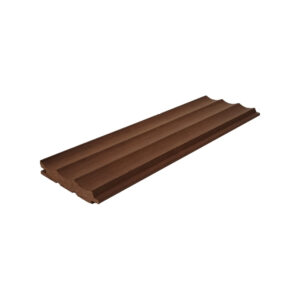
Thermal aspen has become increasingly popular for sauna benches because heat treatment transforms regular aspen wood into a more stable, durable material that handles sauna conditions exceptionally well. The thermal modification process removes moisture and resin while creating a beautiful dark brown colour that will not fade or deteriorate in high-heat, high-humidity environments. This makes thermal aspen an excellent choice for sauna benches where comfort, longevity, and visual appeal matter most.
What exactly is thermal aspen and how is it different from regular aspen?
Thermal aspen is regular aspen wood that has undergone controlled heat treatment at temperatures between 175 and 210 degrees Celsius for 1.5 to 3 days. This process fundamentally changes the wood’s cellular structure, removing water and resin while creating chemical changes that significantly improve its properties.
The thermal modification process begins by rapidly heating the wood to 100 degrees Celsius to remove all moisture completely. Once dry, the temperature is slowly increased to the treatment range using steam and hot air as protective elements. This steam prevents cracking and burning while facilitating the chemical changes within the wood structure.
During treatment, the wood develops its characteristic rich brown colour naturally without any chemical stains or treatments. The process is entirely ecological, using only heat and steam without toxic chemicals. After treatment, the wood is cooled to normal temperature, resulting in beautiful, durable timber with a pleasant natural wood scent.
Regular aspen, while naturally suitable for saunas due to its smooth surface and low resin content, remains lighter in colour and more susceptible to moisture movement and dimensional changes over time.
Why does thermal treatment make aspen better for sauna environments?
Thermal treatment dramatically improves aspen’s resistance to moisture and reduces wood movement, making it ideal for sauna conditions where temperatures and humidity levels fluctuate constantly. The heat treatment process reduces the wood’s ability to absorb significant amounts of moisture, preventing swelling and shrinking cycles.
In sauna environments, untreated wood expands and contracts as moisture levels change, potentially causing gaps, warping, or splitting over time. Thermal aspen maintains dimensional stability because its cellular structure has been permanently altered to resist moisture absorption.
The treatment also enhances the wood’s natural insulation properties, meaning thermal aspen benches stay comfortable to sit on even during intense heat sessions. The smooth surface remains pleasant against the skin without becoming uncomfortably hot or retaining excessive moisture between uses.
Additionally, the thermal modification process creates a more uniform wood structure that responds predictably to temperature changes, eliminating the surprises that can occur with untreated timber in demanding sauna conditions.
What are the main benefits of using thermal aspen for sauna benches?
The primary benefits include exceptional dimensional stability, reduced maintenance requirements, superior appearance retention, and enhanced durability in high-moisture environments. Thermal aspen benches maintain their shape and appearance significantly longer than untreated alternatives.
Maintenance becomes much simpler because thermal aspen does not require regular treatments or protective coatings to maintain its performance. The wood’s natural resistance to moisture means less frequent cleaning and virtually no risk of mould or mildew development in properly ventilated saunas.
The rich brown colour achieved through thermal treatment will not fade or change significantly over time, maintaining the sauna’s attractive appearance for years. This colour consistency eliminates the need for staining or colour-matching when replacing individual boards.
From a comfort perspective, thermal aspen provides the same smooth, resin-free surface as regular aspen but with improved thermal properties. The benches feel comfortable against the skin and do not retain heat excessively, making longer sauna sessions more enjoyable.
The improved stability also means fewer gaps between boards over time, maintaining the clean, professional appearance that quality sauna installations demand.
How long does thermal aspen last compared to other sauna woods?
Thermal aspen typically lasts 15–25 years in sauna applications with minimal maintenance, significantly outperforming untreated aspen and competing favourably with other premium sauna woods. The thermal treatment process extends the wood’s service life by reducing moisture-related deterioration.
Compared to untreated aspen, which may require replacement or significant maintenance after 8–12 years, thermal aspen provides nearly double the service life. The improved dimensional stability means fewer repairs and replacements of individual boards over the sauna’s lifetime.
When compared to other popular sauna woods like cedar or hemlock, thermal aspen offers similar longevity while providing superior comfort due to its smooth, resin-free surface. Unlike some softwoods that can develop rough patches or splinters over time, thermal aspen maintains its smooth texture throughout its service life.
The key advantage lies in thermal aspen’s consistent performance over time. While other woods may show varying degrees of movement, splitting, or colour change, thermal aspen maintains its appearance and structural integrity more predictably, making it easier to plan maintenance schedules and budget for sauna upkeep.
For sauna owners seeking long-term value, thermal aspen represents an excellent investment that combines immediate comfort with extended durability. At Pieksäwood, we specialise in high-quality thermal aspen products manufactured in Pieksämäki, Finland, where traditional woodworking expertise meets modern thermal treatment technology to create superior sauna materials. For more information about our thermal aspen solutions, please contact us today.